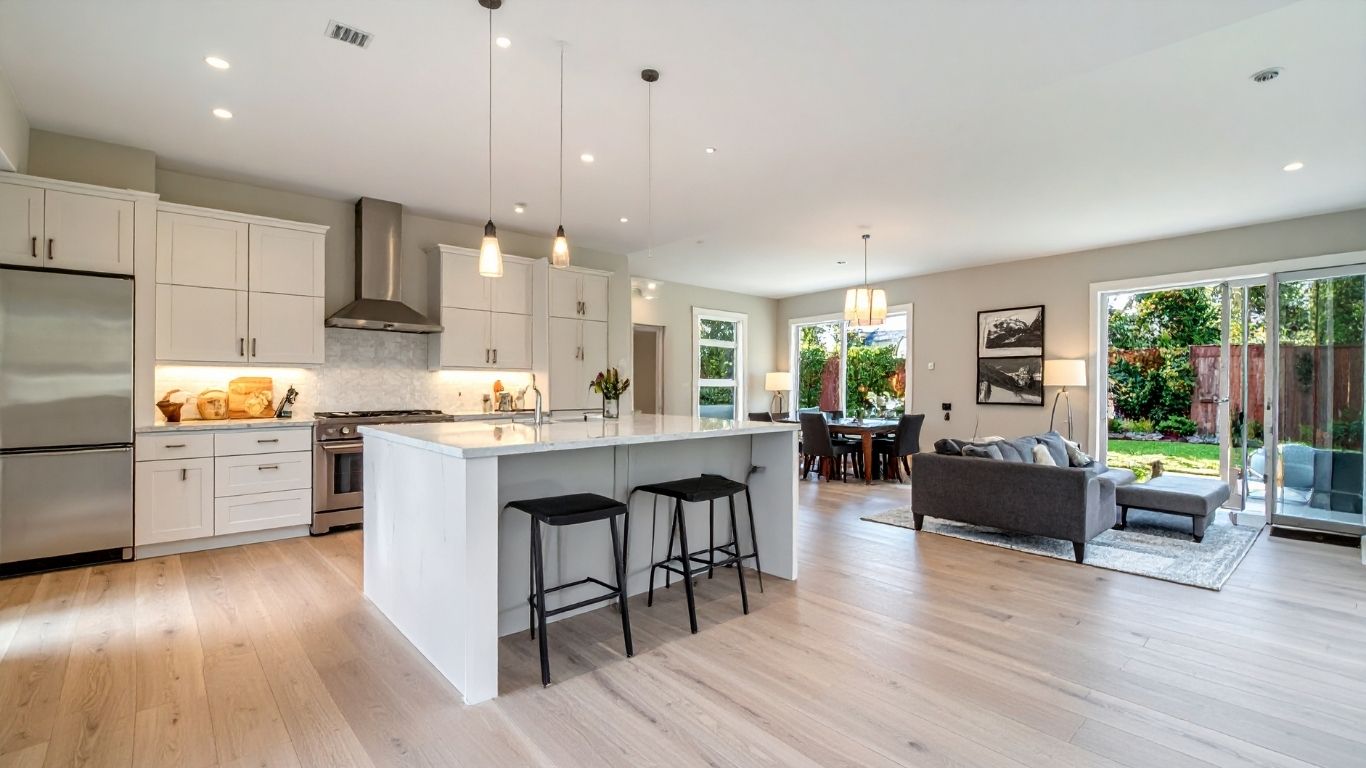
An open concept kitchen renovation can achieve a more connected, airy, and visually expansive feel without changing the structure of your home. The key is to work with what you already have: improving sightlines through cabinet height and color choices, layering lighting, choosing flooring and finishes that flow into adjacent rooms, and using glass-front cabinetry, lower-profile islands, and reflective surfaces to create the visual continuity of an open plan.
If you’re considering an open concept kitchen renovation in your Lehigh Valley home, you may already love the look of an open plan but not be ready to take down walls. The good news is that an open feel comes from many design choices, not just from structural changes. A thoughtful renovation can transform how your kitchen reads, even when the footprint stays the same.
This guide covers the design strategies that achieve an open concept aesthetic through renovation-scope work.
What Does Open Concept Mean in a Kitchen Renovation?
Open concept traditionally refers to floor plans where kitchen, dining, and living spaces share one continuous space without walls. But the visual qualities people love about open concept (brightness, sightlines, flow, a sense of spaciousness) can be achieved through design rather than demolition.
In a renovation, open concept means designing for visual openness:
- Removing visual clutter through better storage and cleaner lines
- Using color, light, and material continuity to bridge the kitchen to adjacent rooms
- Choosing cabinetry and fixtures that don’t visually crowd the space
- Improving sightlines through existing openings
- Bringing in more natural and layered light
These moves don’t require permits beyond the standard scope of a kitchen renovation.
How Does Cabinet Design Create an Open Feel?
Cabinetry has more impact on how open a kitchen feels than almost anything else.
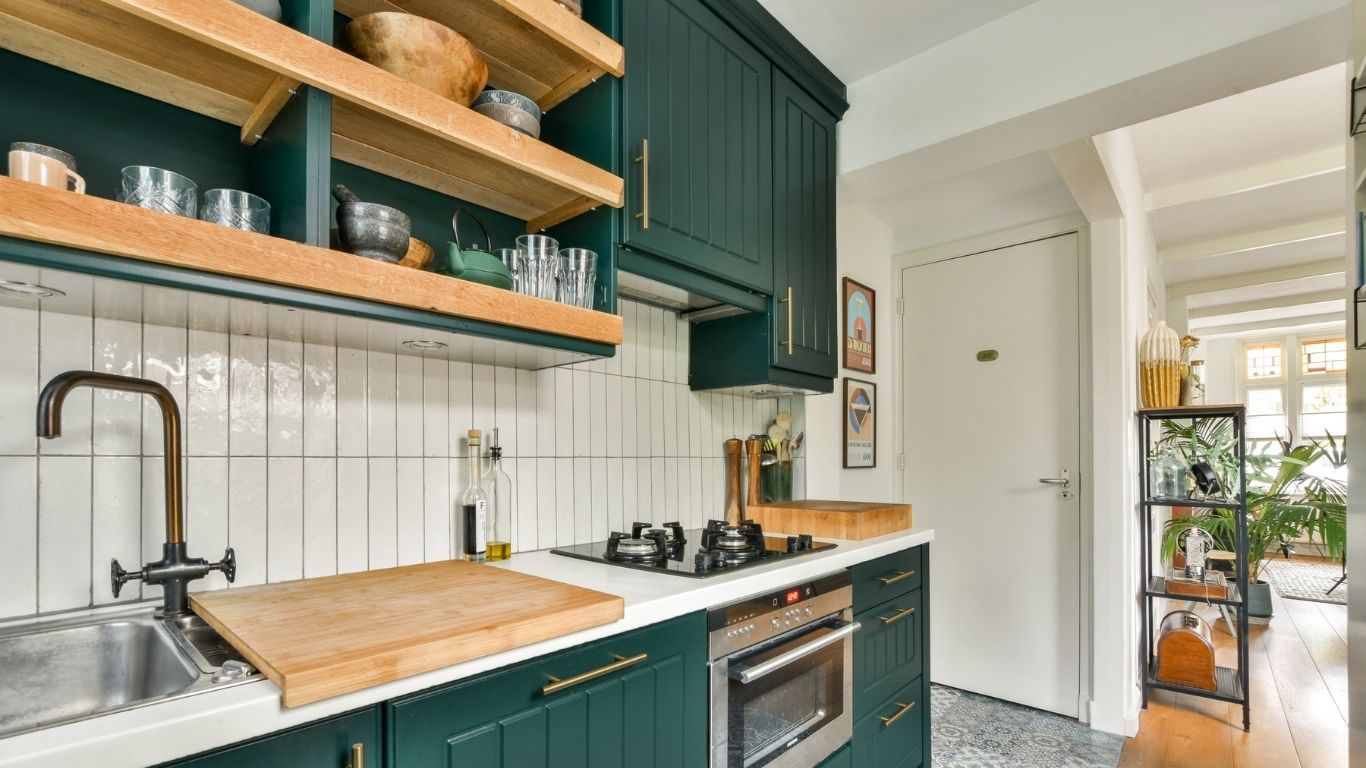
Taller upper cabinets that run to the ceiling
Cabinets that stop at 36 inches and leave a soffit above visually shorten the room. Cabinets that run to the ceiling (or close to it, with crown integration) make the space feel taller and more intentional.
Lighter, less busy door fronts
Painted Shaker or slab doors in white, off-white, or warm neutrals reflect more light and create a calmer visual rhythm. Heavily detailed door styles in dark stains absorb light and make spaces feel smaller.
Glass-front accent cabinets
The 2025 Houzz Kitchen Trends Study found that glass-front cabinets are now the most popular accent door style at 36% of installations. They break up a long run of solid doors and add depth.
Open shelving in moderation
A short run of open shelves in place of upper cabinets opens up sightlines and creates a focal point, especially when the shelves are styled with restraint.
Streamlined hardware
Long horizontal pulls, edge pulls, or push-to-open mechanisms read cleaner than rows of knobs.
For a deeper look at door styles and construction, luxury kitchen cabinets covers selection in detail.
How Does the Island Affect Openness?
The island is the focal point of nearly every modern kitchen, and its scale and proportions affect how open the room feels.
Lower-profile islands feel more open
A standard counter-height island (36 inches) keeps sightlines clear into and through the kitchen. Bar-height islands (42 inches) create more visual barrier.
Single-level beats two-level
A single-level island reads cleaner and more contemporary. Two-level designs (a higher bar over a lower prep counter) chop up sightlines and tend to read dated.
Waterfall edges ground the design
Stone that flows from countertop down the side of the island grounds the piece and reads as architecture rather than furniture. Houzz reports that 52% of upgraded islands now exceed 7 feet, creating a strong center of gravity for the open feel.
Luxury kitchen island ideas for a renovation typically include oversized proportions, waterfall edges, mixed materials, and integrated functions like prep sinks and beverage centers.
What Role Does Lighting Play?
Layered lighting is the single highest-impact change in any open concept kitchen renovation. A kitchen with one overhead fixture always reads as dim and closed. A kitchen with five lighting layers reads as expansive and inviting.
The five layers worth specifying:
- Recessed ceiling fixtures on a regular grid for general illumination
- Pendant fixtures over the island for task and visual focus
- Under-cabinet lighting to wash counters with light and eliminate shadow
- Accent lighting inside glass-front cabinets, in toe kicks, or above tall cabinetry
- Dimming controls on every layer so the room can shift mood
The NKBA 2026 Kitchen Trends Report identifies natural lighting (95%), quality lighting (93%), and task lighting (92%) as the top three design priorities. Under-cabinet lights (82%), interior cabinet lights (72%), and pendant lights (63%) lead the fixture selections.
How Do Color and Material Continuity Open a Space?
A kitchen that uses different flooring, paint, and trim from the adjacent dining or living areas reads as a separate room. A kitchen that bridges those choices reads as part of a connected space, even with walls in between.
Continuous flooring across rooms
Wide-plank engineered hardwood that runs from the kitchen through the adjacent rooms removes the visual break that traditional kitchen tile creates.
Bridge paint colors between rooms
Walls in the kitchen and the adjacent room in the same color, or in two warm neutrals from the same family, make the spaces read as one.
Repeated trim profiles throughout
Crown molding, base, and casing that match between rooms create rhythm. The best high-end materials for a custom home hold up to decades of use, and millwork is one of the categories where material choice matters most.
Echoed materials in furniture and finishes
A wood tone in the kitchen island that appears again in adjacent shelving knits the spaces together.
What Existing Openings Can You Improve?
Many older Lehigh Valley homes already have openings between the kitchen and adjacent rooms. They just don’t take full advantage of them.
Update an existing doorway
Replacing a swinging solid door with new casing and a more open treatment makes the existing opening feel more generous.
Open up an existing pass-through
A pass-through that already exists between a kitchen and dining room can be deepened, refinished, or improved with new lighting to feel more intentional.
Replace solid doors with glass
A swinging solid door visually closes the space. A glass door, a sliding barn door, or a pocket door dramatically opens it.
Enlarge an existing window
Replacing a small kitchen window with a larger one within the same rough opening pulls in significantly more natural light.
Frequently Asked Questions
Can I get an open concept kitchen in the Lehigh Valley without removing walls?
Yes. A well-planned renovation can deliver the brightness, sightlines, and visual flow of an open plan through cabinetry, lighting, color continuity, and improved openings, all without structural changes.
What’s the difference between an open concept renovation and a remodel?
A renovation works within the existing footprint. A remodel changes the footprint, typically by removing walls or expanding the kitchen. Russo Design + Build focuses on renovation-scope work.
Will an open feel still add resale value in Bethlehem or Easton?
A lighter, brighter, more connected kitchen consistently performs better on listings across Bethlehem, Easton, and the surrounding communities. Buyers respond to visual openness regardless of whether it came from structural work.
How long does an open concept kitchen renovation take?
Most renovations of this scope run 3 to 5 months total. The full sequence is laid out in the kitchen renovation timeline.
Do I need an architect for this kind of renovation?
Not usually. A skilled kitchen designer working with an experienced builder handles the design for renovation-scope work.
Ready to Open Up Your Kitchen?
An open concept kitchen renovation that works within your existing footprint can transform how the space lives without the cost and complexity of structural work. The Russo Design + Build team has handled high-end kitchen renovations across Allentown, Bethlehem, Easton, and surrounding communities.
Call (484) 239-8316 or book a design consultation to walk through what’s possible in your home.